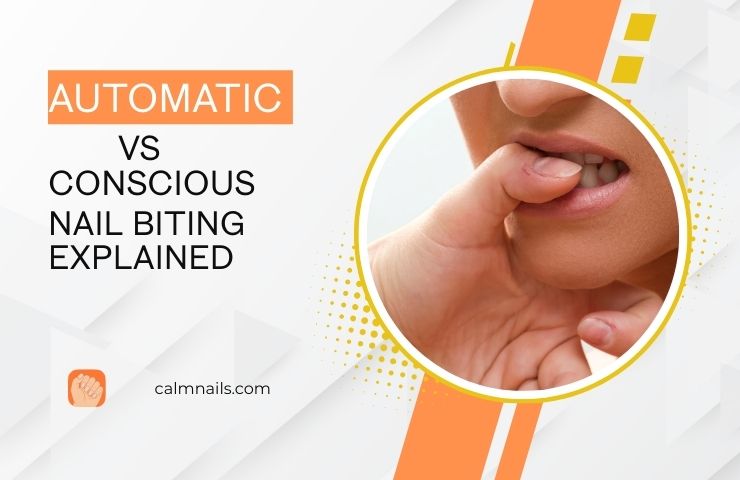
Nail biting is one of those habits people talk about casually, almost jokingly, yet struggle with for years. Many try to stop by relying on willpower, keeping their hands busy, or covering their nails. Some succeed for a short while, only to fall back into the same pattern during moments they barely notice. That cycle often leads to frustration and self-blame.
What most people never realize is that nail biting is not a single behavior. It shows up in different ways, driven by different mental and emotional processes. Until you understand which pattern you are dealing with, every attempt to stop feels harder than it needs to be.
This article breaks nail biting into two distinct types: automatic nail biting and conscious nail biting. By understanding how each one works, you can begin to respond in a way that feels realistic, supportive, and sustainable.
TL;TR
Most people bite their nails in one of two ways. Automatic nail biting happens without awareness during thinking, scrolling, or waiting. Conscious nail biting happens with awareness and is often linked to emotional discomfort or tension. Many people experience both. The key to reducing nail biting is not forcing yourself to stop, but learning to recognize when and why it happens. Awareness creates a pause, and that pause is where real change begins. Tools like CalmNails are designed to support this process by helping people notice patterns gently rather than fight themselves.
Why Nail Biting Is Often Misunderstood
Nail biting is usually labeled as a bad habit. That label feels simple, but it hides what is actually happening beneath the surface. Habits are not random. They serve a function, even when they are unhelpful.
When people say, “I just bite my nails without thinking,” they are describing one kind of pattern. When others say, “I know I am doing it but I cannot stop,” they are describing a different one. Treating both situations the same way creates confusion and disappointment.
Understanding the difference is not about diagnosis or labels. It is about clarity. Once you know how your habit operates, you can respond with the right kind of awareness instead of frustration.
Nail Biting Is Not One Behavior
From a behavioral perspective, nail biting falls under what psychologists call body focused repetitive behaviors. These are actions that repeat, often involving the hands, and are closely tied to mental states like focus, stress, boredom, or emotional regulation.
What matters most is not how often you bite your nails, but how it begins.
Some patterns are automatic. They happen when the mind is occupied elsewhere. Others are conscious. They happen when a person is aware of the urge and continues anyway.
Both are common. Neither means something is wrong with you.
What Is Automatic Nail Biting?
Automatic nail biting happens without conscious decision. It is not driven by a strong urge or emotional distress in the moment. Instead, it occurs when attention is directed elsewhere.
This type of nail biting often appears during activities such as:
- Deep thinking or problem solving
- Reading or working on a screen
- Waiting in line or sitting idle
- Scrolling on a phone without much awareness
In these moments, the hands move on their own. Many people only realize what happened after the fact, when they notice damage to their nails or feel soreness.
Automatic nail biting is closely connected to the nervous system. It acts as a background behavior, similar to fidgeting or tapping a foot. The body seeks mild stimulation or comfort while the mind is occupied.
Importantly, people who experience this type of nail biting usually do not feel strong emotional distress while it is happening. The behavior feels neutral, almost invisible.
Signs You Might Be an Automatic Nail Biter
You may relate to automatic nail biting if:
- You often do not remember biting your nails
- You notice it mostly when someone points it out
- It happens during calm or neutral moments
- The habit stops as soon as you become aware of it
For many people, this pattern explains why they feel confused. They genuinely want to stop, but they rarely catch themselves in the act.
What Is Conscious Nail Biting?
Conscious nail biting is different. In this pattern, the person is aware that they are biting their nails. There is usually a noticeable urge, often linked to emotional discomfort.
This type of nail biting often appears during:
- Stressful situations
- Feelings of anxiety or restlessness
- Moments of frustration or overwhelm
- Emotional discomfort that feels hard to sit with
Unlike automatic nail biting, conscious nail biting involves choice, even if that choice feels limited. People often describe it as something they know they should stop, but feel compelled to continue.
This pattern can feel more intense because it is tied to emotional regulation. The act of biting provides temporary relief or grounding, even if it leads to regret later.
Signs You Might Be a Conscious Nail Biter
You may recognize this pattern if:
- You feel an urge before biting
- You associate the habit with specific emotions
- You focus on certain nails repeatedly
- Stopping feels uncomfortable or incomplete
Conscious nail biting often comes with self-judgment. People blame themselves for not having enough control, even though the behavior is serving a coping function.
Why Many People Experience Both
It is very common to experience both automatic and conscious nail biting. The pattern can shift depending on the situation.
For example:
- During work or scrolling, nail biting may be automatic
- During stress or emotional tension, it may become conscious
This overlap is one reason people struggle to describe their habit clearly. It also explains why some techniques work sometimes but not others.
Understanding that these patterns can coexist removes the pressure to find one perfect solution.
Why Willpower Alone Does Not Work
Willpower assumes that the behavior is always a conscious choice. That assumption does not hold true for automatic habits.
For automatic nail biting, willpower cannot stop what you do not notice. For conscious nail biting, willpower often increases tension and self-criticism, which can actually strengthen the urge.
When people rely only on control, they often experience:
- Short periods of success
- Followed by relapse during stress or distraction
- Increased frustration and self-blame
This cycle is exhausting and unnecessary.
The Role of Awareness in Changing Nail Biting
Awareness is not about constant monitoring or self-policing. It is about noticing patterns without judgment.
For automatic nail biting, awareness creates interruption. The moment you notice your hand near your mouth, the behavior pauses naturally.
For conscious nail biting, awareness creates choice. You may still feel the urge, but you are no longer acting on autopilot.
Awareness works differently for each pattern, but it is essential for both.
How Awareness Helps Automatic Nail Biting
With automatic nail biting, the goal is not to stop the habit instantly. The goal is to bring it into consciousness gently.
Over time:
- You begin noticing earlier in the movement
- The habit shortens in duration
- The frequency naturally decreases
This process works because the nervous system responds to attention. The habit no longer runs unnoticed in the background.
How Awareness Helps Conscious Nail Biting
With conscious nail biting, awareness helps you sit with the urge instead of reacting immediately.
This does not mean resisting forcefully. It means recognizing the feeling without judgment.
Over time:
- The urge becomes less intense
- The sense of compulsion weakens
- You regain a feeling of choice
This approach builds trust with yourself rather than conflict.
A Simple Self Reflection Exercise
Instead of asking, “How do I stop biting my nails?” try asking:
- When does it usually happen
- What am I doing just before it starts
- Do I notice it immediately or afterward
- Is there an emotional tone present
These questions are not meant to be answered perfectly. They are meant to build curiosity.
How CalmNails Supports Both Patterns
CalmNails is designed around the idea that awareness comes before control. Rather than focusing on punishment or pressure, it supports noticing.
For automatic nail biting, CalmNails helps by:
- Bringing attention to unconscious moments
- Creating gentle interruptions
- Encouraging consistency without force
For conscious nail biting, CalmNails helps by:
- Supporting awareness during urges
- Reducing self-judgment
- Encouraging calm reflection rather than resistance
The goal is not perfection. The goal is progress through understanding.
You can explore this approach further at www.calmnails.com, where the focus is on building sustainable awareness instead of relying on willpower alone.
Why Change Happens Slowly and That Is a Good Thing
Habits that develop over years do not disappear overnight. That does not mean change is failing.
Small pauses add up. Each moment of awareness weakens the old pattern slightly. Over time, those moments reshape behavior naturally.
This is how lasting change happens.
Final Thoughts
Automatic and conscious nail biting may look the same from the outside, but they are driven by different processes. When you understand which one you are dealing with, the habit stops feeling mysterious or personal.
You are not broken. Your nervous system learned a pattern, and patterns can change.
The first step is not stopping. It is noticing.
FAQ
Is nail biting always related to anxiety?
Not always. Automatic nail biting often happens during neutral or calm moments. Conscious nail biting is more likely to be linked to emotional discomfort, but it does not always mean an anxiety disorder.
Why do I bite my nails more when I am bored?
Boredom creates mental under-stimulation. Automatic habits like nail biting provide mild sensory input, which can feel grounding.
Can nail biting stop without willpower?
Yes. Many people reduce nail biting significantly through awareness and habit interruption rather than force.
Why do I relapse after making progress?
Relapse usually happens during stress or distraction. It does not erase progress. It shows which pattern needs more awareness.
How long does it take to see change?
This varies. Some people notice changes within weeks, others over months. Consistency matters more than speed.
If you want to explore a calmer, awareness-based way to reduce nail biting without pressure or shame, visit www.calmnails.com. CalmNails is built to help you notice patterns gently, create meaningful pauses, and support long-term change that feels human and sustainable.
You may also find this helpful: Micro-Habits That Reduce Cognitive Overload Without Disrupting Work
Leave a Reply